Raptor migration past Batumi
In 1999 a study into the importance of a migratory bird flyway along the Georgian Black Sea coast (in the Caucasus) was initiated by Erwin van Maanen et al. (1998; 2001a & 2001b) as part of the development of a biodiversity center in the harbor town of Batumi and the advancement of nature conservation research and management in the Caucasus. This was achieved under the Black Sea Environmental Program and in collaboration with the Georgian Center for the Conservation of Wildlife (GCCW).
The study was based on earlier accounts on the importance of raptor migration and the shooting and trapping of raptors in the foothills along the eastern Black sea coastline of Turkey by Gernant Magnin (1989). The initial study on the Georgian side of the border revealed that the coastal fringe of the Adjaria-Imereti mountain range, in a north-south trajectory, is indeed of great importance as a migratory route and bottleneck for a great diversity and tremendous volume of birds, in particular birds-of-prey. In terms of volumes and diversity of birds, it exceeds other well-known passageways along the Mediterranean, like Gibraltar and the Bosporus (Van Maanen 1998; Van Maanen et al. 2001b).
The Batumi bottleneck is part of a larger flyway across the Trans-Caucasus, with other but smaller concentrations of, or stowed bird migrations across inland regions. These are dictated by mountain ridges and valleys, including for example the Zekari pass in the lesser Caucasus and the Dariali Gorge in the Greater Caucasus (Van Maanen et al. 2001b).
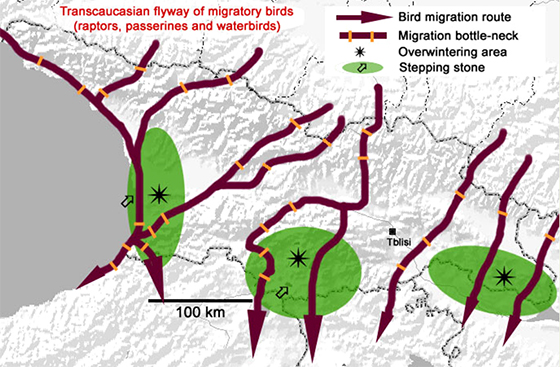
The Black Sea in combination with the lush subtropical foothills, which in the hot and humid fall produces warm updrafts or thermals, present an energetically ideal gateway for passive migrants like soaring birds-of-prey (for example thousands of Honey-buzzards Pernis apivorus), but also to countless more active flyers like Accipiters, harriers and falcons and other birds like rollers, bee-eaters, orioles, nightjars and quails. Over the coastal Black Sea and the lowland plains, including Kolkheti Wetlands, a wide range of other birds may be observed passing low overhead or resting; including rarities.
A bottleneck of great importance previously unknown
Actually, the significance of the migratory flyway was already known and reported during the Soviet era (Abuladze 1994 & 1997) and even before (Villkonskii 1897). For a long time it remained unknown and unappreciated in the West until more European birders started to visit and explore Georgia in the last five years. Before that several conservation initiatives were undertaken by the GCCW in partnership with BirdLife International, facilitated by Erwin van Maanen from EcoNatura.
This included the initiation of systematic bird counting, the production of educational materials – including a beautifully illustrated Georgian raptor identification guide (Gálvez et al. 2005) – and motivation for the protection of raptors to the environmental authorities. The first edition of the raptor identification guide for the Caucasus was produced with illustrations by Dutch bird artists, including Erik van Ommen.
More systematic, organised and well-supported counts by a group of young Belgian ornithologists started in 2008 and revealed to date that an estimated million migratory birds pass the Batumi bottleneck during the fall (Verhelst et al, 2011; → Batumi Raptor Count where the current tally is kept). In spring the number of birds through the Batumi bottleneck is much less, perhaps due to alternative and more diffuse routes across the Caucasus from wintering to breeding grounds.
Very little is known about the origins of many of the bird species, particularly those from the Eastern Palearctic. We do know for instance, from recovery of rings, that Honey-buzzards from Fenno-Scandinavia pass through.
However, there is much more to learn about the biogeography of the birds and the differential migration of cohorts of age and gender. New techniques like the analysis of stable isotopes (isotope ecology) and satellite telemetry may present novel research opportunities. This may reveal new information about migratory biology, as well as the range and population ecology of species, not to forget new insights into the state of the environment with respect to land use changes and the effects of climate change within the Western and Eastern Palearctic.
The views of the raptor migration in the foothills of the Adjarian Mountains, including hilltops like in the village area of Machindjauri and Orta Batumi, just north of the harbor city, are nothing less than spectacular. For example, on 24 September 2012, in Orta Batumi and close to the Mtirala National Park, during a warm clear day just after a few days of rain, hundreds of Honey buzzards, steppe buzzards, Black kites and Marsh harries could be seen rising on the thermals and then gliding south; wave after wave. Among them tens of Pallid harrier, Booted eagle, Short-toed eagle, Lesser-spotted eagle, Levant sparrowhawk, kestrel and an occasional Red-footed falcon. Specialties during that day were several Imperial eagles (a group of three), Long-legged buzzard and a Dalmatian pelican (!).
The trapping and shooting of raptors
Unfortunately the joy of watching the continuous flow of migratory birds in the Batumi foothills and in the Chorokhi can be spoiled by hunters, who shoot a large number of low flying raptors of all sorts, and also other migratory birds. In fact they shoot at everything flying within range, mostly for sport and fun.
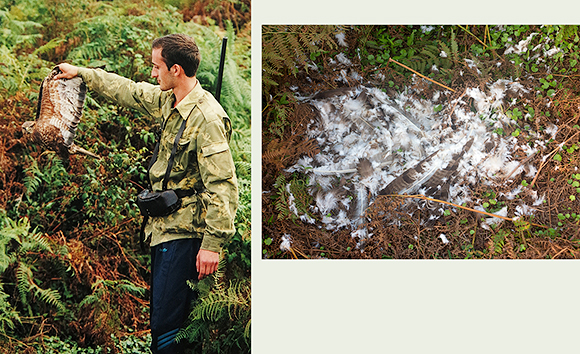
Above – Left: Hunter with a Steppe buzzard Buteo buteo vulpinus he just shot (Makhindjauri, fall of 1999). Right: Remains of a shot Honey-buzzard at Makhindjauri in the fall of 2012.
Some hunters eat Honey-buzzards Jajia as a delicacy, but the other raptors Irao are regarded as distasteful.
Beside the hunters in the hills are the falconers, who trap juvenile Eurasian sparrowhawks and goshawks to train for falconry activities in the late fall (Van Maanen et al. 2001). The raptors are caught using a blinded Red-backed shrike as lure behind a sail-shaped net.
Occasional by-catch such as Levant sparrowhawks, kestrels and hobbies, and even a disproportional number of rarities or less-tempted birds like Pallid, Ferruginous harrier and Short-eared owl, are regarded as useless and killed to feed the birds kept for falconry, as their remains around the trappers huts show. Only rarely a highly prized Peregrine or Saker falcon is caught. There is also talk of a very rare and special “white falcon”, which could refer to a pale version of a Tundra peregrine falcon Falco peregrinus calidus.
Falconry activities include mainly the hunting for quails and corncrakes and participation in several falconry competitions.
Falconry is an age-old tradition in Georgia, shared with counterparts on the Turkish coastline from Sarpi to around Trabzon; where, however, the mistreatment of raptors is perhaps curtailed these days instead of unregulated like in Georgia.
It is estimated that between 3000-7000 raptors die (Van Maanen et al. 2001a and pers. comm. J. Janssen) from the shooting, trapping and falconry each year in Georgia, not counting the birds that are taken from nests in inland Georgia, including falcons, eagles and vultures.
Unfortunately and despite the intended accession to the European community, the ban on, or rather the enforcement of environmental law regarding the protection of migratory birds and other biodiversity or natural assets, still needs to be effectuated in Georgia, and on many other fronts as well.
References
Abuladze, A. (1994) Birds of Prey in Georgia in the 20th Century. In: Meyburg, B.-U. and R.D. Chancellor, eds. Raptor conservation today. World Working Group of Birds of Prey. London: Pica Press.
Abuladze, A. (1997). Status and conservation problems of raptors in Caucasia. Newsletter World Working Group of Birds of Prey 26/27: 15–19.
Fenech, N. (1992) Fatal flight: the Maltese obsession with killing birds. London: Quiller Press.
Gálvez, R.A., L. Gavashelishvili & Z. Javakhishvili 2005. Raptors and owls of Georgia. Buneba Print/ Georgian Centre for the Conservation of Wildlife, Tblisi, Georgia.
Magnin, G. (1989) Falconry and hunting in Turkey during 1987. Cambridge, U.K.: ICBP (Study Report 34).
Villkonskii, F.V. 1897. Ornithological fauna of Adjaria, Guria and northeastern part of of Lazistan. Materials on the study of Fauna and Flora of the Russian Empire. Journal of the Russian Zoological Society 3:1-121.
A unique system of wetlands on the eastern Black Sea shore in Georgia
Georgia in the Caucasus is situated on the nexus of Asia and Europe and harbors one of the World’s biodiversity hotspots (Meyers 2000; Cincotta et al. 2000).
When Jason and the Argonauts hit the eastern Black Sea shore – now western Georgia – on their quest to find the Golden Fleece, they must have encountered a land with great promise. The subtropical central or sub-Mediterranean lowland region of Kolkheti along the east coast of the Black Sea is particularly well-endowed with different wetland types, and these in turn are part of an important network of wetlands around the Black Sea (Wilson & Moser 1994; Marushevsky 2003). These wetlands are fed by frequent and often heavy rains (on average 2200 mm annual rainfall) and by a multitude of rivers and underground streams (seepage) from the Atchara-Imereti and Greater Caucasus ranges. This constant water supply made it very difficult to drain wetlands in the region during the Soviet Era. Even today the drainage through many ditches and channels continues, although in many places stalled due to lack of maintenance.
The system of wetlands in Kolkheti lowland from the southern border of the Republic of Abkhazia, extending to the Kakhaberi plain on the Georgian-Turkish border in the south, is comprised of river delta’s (including the major Rioni and Chorokhi rivers), lakes, (fish)ponds and extensive wet meadows, fen marshes, mires and unique percolation bogs (Ispani II and Imnati). Some of the Alder-forested marshes are reminiscent of wetlands in northwestern Europe, like the Weerribben-Wieden in the Netherlands.
The vegetation across the region is divers, including huge Sphagnum-dominated bogs to alder brooks with extensive canals and lakes, also fringed by broad reed lands. The wetlands also connect with other special ecosystems like the Euxine-Colchic broadleaf forests, coastal dunes and areas of steppe from the east, in places forming unique ecotones.
The ecohydrologically unique Ispani II mire is one of the best studied of the percolation bog systems in the region, with research initiated on the basis of sheer coincidence during a Wetlands International meeting in Moscow in 1998 by Erwin van Maanen of EcoNatura and a research team from the University of Greifswald (Germany) led by Prof. dr. Hans Joosten. This research, as well as a conservation programme and including the training of Georgian ecologists and involvement with the International Mire Conservation Group (IMCG), continues today (Haberl et al. 2006; Krebs et al. 2009).
The central part of the Kolkheti wetlands has been protected as national park under de Ramsar Convention since 1999. Their protection is greatly facilitated and promoted by the NGO Tchaobi, led by botanist Izolda Matchutadze and supported by the World Bank sponsored IZCM project.
The biodiversity of the region is poorly characterised and in need of a systematic and phenological survey. Birdlife is the best known and documented (Gavashelishvili et al. 2006).
For example, the fish fauna is of great importance ecologically and economically. For instance, at least three of the five Black Sea sturgeon species and the endemic Black Sea Salmon (Salmo labrax) are believed to still spawn in the Tikori and Enguri Rivers, but continued poaching are bringing them to extinction. Surveys of sturgeon have unfortunately stopped with the passing away of Dr. Zurab Zarqua, a Georgian sturgeon specialist.
Of the wetland mammals, the otter is of conservation concern and the occurrence of another Mustelid – the European mink – is not unthinkable. The Golden jackal is the most common of the larger mammalian predators. The wetlands hold important populations of breeding birds including several species of herons, grebes, birds of prey, waterfowl, rails & crakes and passerines. Sadly – once common – pelicans now only sporadically occur and only two breeding pairs of White-tailed eagle are known to exist today. The wetlands also present vital wintering and storm refuge sites for many birds. Moreover, huge numbers of migratory birds pass and rest in the region during the autumn and spring migration, including around a million raptors in the fall.
Perhaps now only a small detail, the wetlands are also the original breeding grounds of the now very rare and endemic Common pheasant Phasianus colchicus, commonly introduced as a game species elsewhere around the world.
The sub-tropical Euxine-Colchic broadleaf forests extending in parts still from the Adjarian mountains (including Mtirala National Park) to the coast (the Botanic garden in Batumi still holds a fragment right on the sea shore) is also a poorly known forest system. These forests from broadleaved to sub-alpine zones are home to unique and endemic species, including the Caucasian salamander (Mertensiella caucasica).
The mountain forests are strongholds for poorly known populations of mammals, including the brown bear, wolf, lynx, wild cat, pine marten, red deer, and other wild herbivores, and a diverse smaller mammal community.
A system under great threat
However, these important and seemingly underexposed wetlands have been, and still are, greatly impacted by anthropogenic activities. As early as 1907 N.N. Shavrov of the Russian Geographers Society predicted the degradation of Kolkheti Wetlands and threats to important inhabitants like birds. As much as 60% of the original wetland area has since been claimed and cultivated for pastures, agriculture and horticulture, a process continuing today and particularly enhanced by rapid urbanisation along the coast.
The increasing degradation of the remaining wetlands was and is currently forced by severe pollution, eutrophication, peat exploitation, over-exploitation of fauna (poaching), illegal logging, drainage, overgrazing, sand and gravel extractions, normalization of flowing waters, invasive species and feral animals. Major developments are in the pipeline, including the ambitious and controversial building of a new city (Lazika) in the Anaklia marshes, oil storage and transfer facilities, extension of a tourist boulevard into the Chorokhi Delta, and hydroelectric dams in the major rivers.
Without wise planning and management Kolkheti Lowlands will definitively turn into a hotchpotch of disturbed and disheveled sites. This will inevitably lead to great landscape and biological diversity losses, making the region unattractive for ecotourism. Nature is a great asset for Georgia, yet little appreciated. Of paramount importance to the economic viability of the region, the Kolkheti wetlands provide vital ecosystem services including carbon sequestration against climate change (and hence sea rise, including the Black Sea), coastal stabilisation, buffering against flooding on the low lying Colhic plain, and food and fibre provision (Goradze 2008).
References
Abuladze, A. (1994) Birds of Prey in Georgia in the 20th Century. In: Meyburg, B.-U. and R.D. Chancellor, eds. Raptor conservation today. World Working Group of Birds of Prey. London: Pica Press.
Cincotta, R.P., J. Wisnewski and R. Engelman 2000. Human populations in biodiversity hotspots. Nature 404:990-992.
Gavashelishvili, L., Z. Javakhishvili & G. Darchiashvili 2006. Field guide to the birds of Kolkheti Wetlands. Buneba Print/ Georgian Centre for the Conservation of Wildlife, Tblisi, Georgia.
Marushevsky, G. 2003. Directory of Azov-Black Sea coastal wetlands. Wetlands International, Kyiv.
Myers, N, R.A. Mittermeier, C.G. Mittermeier, G.A.B da Fonseca and J. Kent 2000. Biodiversity hotspots for conservation priorities. Nature 403:853-858.
Tarkhnishvili, D.N. & I.A. Serbinov 1993. The ecology of the Caucasian salamander (Mertensiella caucasica) in a local population. Asiatic Herpetological research 5:147-165.
Wilson, A.M. and M.E. Moser 1994. Conservation of Black Sea wetlands. A review and preliminary action plan. IWRB Publication 33, Slimbridge.